

Short on time? Skip the reading.
Have you ever stopped to look at your logo and asked yourself: “Is this actually helping my business, or is it just… there?”
It is an uncomfortable question, but a necessary one. Many successful businesses operate with the same logo they started with 5 or 10 years ago. And while that design has sentimental value, it may technically no longer be up to the standards of the company you have become.
I am not here to tell you that you need to tear everything down and start from scratch. Sometimes, you don’t need a total demolition; you just need a smart renovation. Let’s put your brand under the microscope.
The “Temporary Logo” Syndrome
Let’s be honest about how many logos are born. When you launch a business, budgets are tight. Maybe a friend designed it in Photoshop, you made it yourself during a late-night inspiration burst, or you bought it for $20 on a generic website.
That logo had one mission: to exist. And it did its job.
The problem arises when your revenue grows, your team expands, and your service quality increases, but your logo still screams “home-based business.” The lack of a Strategic Concept is the number one mistake. A logo isn’t just a pretty picture; it’s a communication tool. If it was created without thinking about your audience or your value proposition, it is merely decoration.
Technical Mistakes That Kill Your Image (And How Giants Fixed Them)
Even the world’s biggest companies have had “bad” logos.
Look at Apple. In 1976, their first logo wasn’t the bitten apple. It was a complex, antique illustration of Isaac Newton sitting under a tree, complete with a border and medieval-style text.
- The Problem: It was an illustration, not a logo. It couldn’t be reduced, it wasn’t readable from a distance, and it looked old-fashioned before its time.
- The Solution: Radical simplification. They moved to the iconic apple symbol.
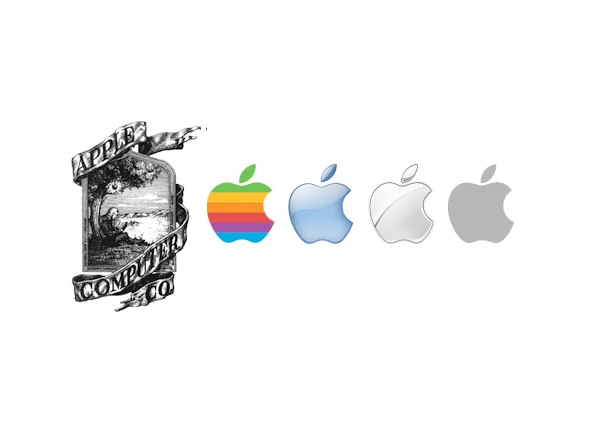
The 1976 illustration (left) was impossible to read at small sizes. The evolution to a simple icon wasn’t just a style change—it was a strategic necessity for scalability and instant recognition.
This teaches us two lessons where growing businesses often fail:
- Images vs. Logos: Many owners use a photograph or a complex illustration (with shadows, excessive gradients, or too many details) as a logo. The Golden Rule: If you can’t embroider it on a cap or print it on a pen and still recognize it, you have a technical problem.
- The Clipart Trap: Using generic icons (the typical abstract “swoosh,” the globe, the puzzle piece) makes you invisible. If your logo looks like 100 other companies, you don’t have a brand; you have a commodity.
The 3 “Silent Killers” of Your Business Image
You don’t need a degree in design to know when something feels “off.” If your logo falls into one of these traps, you aren’t just breaking design rules—you are confusing your customers.
1. The “Mixed Signals” Trap (Typography) Think of typography as your brand’s tone of voice.
- The Mistake: Using a “fun” or “cute” font for a serious business (like finance or law), or a stiff, old-fashioned font for a tech startup.
- The Business Impact: If you sell security and high-value consulting, but your font looks like it belongs on a birthday invitation, customers won’t trust you with their money. It’s a subconscious clash: your words say “Expert,” but your logo says “Amateur.”
2. The “Description” Trap (The Icon) Many business owners think a logo must explain exactly what they do.
- The Mistake: Using a generic icon found in clip-art libraries. A tooth for a dentist. A roof for real estate. A burger for a restaurant.
- The Business Impact: If your logo describes what you do, you look exactly like your competition. You become invisible. Great brands sell a concept, not a product. Starbucks is a mermaid, not a coffee bean. Apple is a fruit, not a computer. If you look like everyone else, the only way to compete is by lowering your prices.
3. The “Fragile Logo” Trap (Functionality) In 2024, your logo needs to survive in the wild.
- The Mistake: Having a complex logo with shadows, gradients, or tiny details that look great on a big monitor but turn into a messy smudge on a smartphone.
- The Business Impact: Does your logo vanish when your client uses “Dark Mode” on their phone? Is it unrecognizable as a tiny Instagram profile picture? If your logo isn’t flexible, you look outdated. A modern business needs a logo that works everywhere, from a giant billboard to a tiny app icon.
The “Tough Love” Checklist: Audit Your Brand in 1 Minute
Forget about personal taste. Ask these 5 business questions with a strict YES or NO:
- The “Competitor” Test: If I put my logo next to my biggest competitor, does mine look like the cheaper option?
- The “Silhouette” Test: If I turn my logo completely solid black (no colors, no effects), is the shape still recognizable?
- The “Tiny” Test: Can I shrink it to the size of a coin (or an app icon) and still read it clearly?
- The “Story” Test: Can I explain the meaning of my logo without saying “because I liked the blue color”?
- The “File” Test: Do I own a professional vector file (EPS/SVG)? (Note: If you only have a JPG or PNG, the answer is NO).
If you answered “NO” to more than two questions, your brand is likely holding you back.
You Don’t Always Need a Full Rebrand
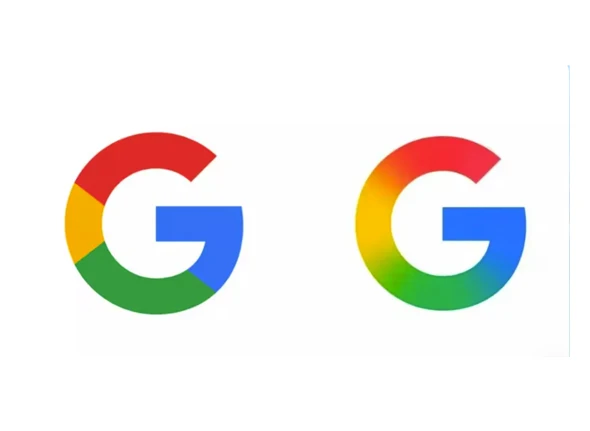
Major brands like Google, Burger King, or Mastercard make subtle adjustments (Restyling) every few years. They clean up lines, adjust colors, and modernize typography. The goal is to stay fresh without losing their essence.
Want an Impartial Second Opinion? Use AI.
Sometimes it is hard to be objective with something you own. That is why I have created a ChatGPT Prompt specifically designed to act as an impartial design critic.
You can upload your logo, and the AI will analyze technical aspects like balance, contrast, and readability, giving you a preliminary report without emotional bias.
Conclusion
Your logo is the face of your hard work. It deserves to look as professional as the service you deliver. Whether you need a technical tweak or a strategic redesign, the first step is accepting that there is always room for growth.